
Stop Building Alone: A 3-Step System to Find the Right Partners (Without Wasting Time)
A practical kit to map your gaps, score partners objectively and stress-test fit with AI, so every collaboration compounds your traction. (don't miss the AI-powered FREE tool)

The founder mistake I see everywhere and made myself
For months, I chased “the perfect partner”: more meetings, more intros, more “let’s circle back.” The problem wasn’t effort. It was misalignment.
I was asking for help before I knew what I actually needed and I had no system to tell a great fit from a time sink.
Here’s what turned it around: treating partnerships like product. Define, test, iterate.
That mindset is what corporates call open innovation and it works beautifully for solopreneurs and early teams when you strip out the bureaucracy.
This article gives you my 3-step system (and a ready-to-use kit 'free') to do exactly that.
The shift: partners are multipliers, not miracles
The right partnership can collapse months of grind:
a distribution partner brings customers you’d never reach alone,
a media/community partner brings trust your ads can’t buy,
a strategic collaborator gives you capabilities you don’t have yet.
But only if you’re brutally clear on -
(1) what you have
(2) what you lack
(3) the shared win
and you evaluate fit with the same rigour you’d use for hiring.
The 3-Step System (use it in 30–45 minutes)
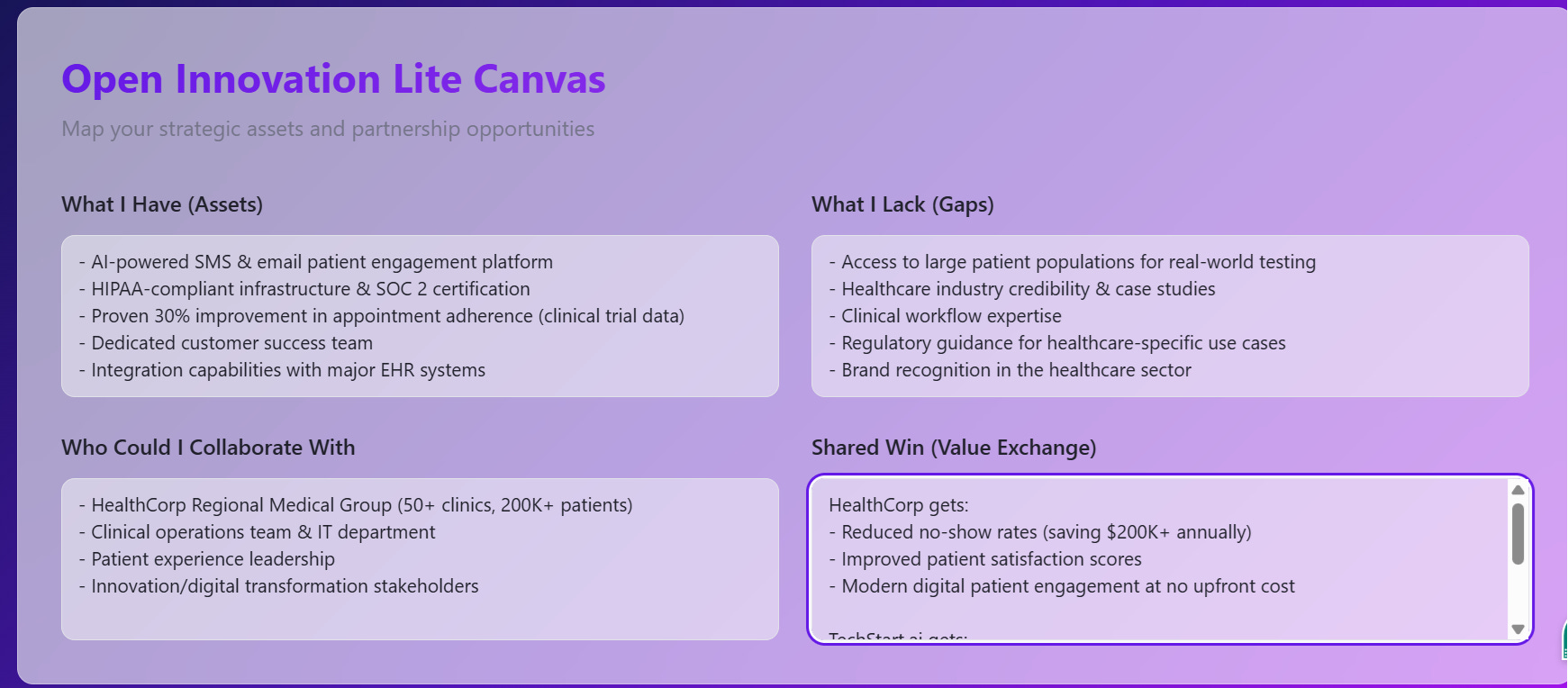
1) Map your collaboration thesis (Open Innovation Lite Canvas)
Fill four boxes on one page:
What I Have (assets): audience segments, ICP proof, product strengths, case studies, unique IP, credibility.
What I Lack (gaps): distribution in X niche, demo credibility, technical skill, market proof, region access.
Who Could I Collaborate With: communities, tools, creators, agencies, accelerators, niche newsletters, VCs/angels.
Shared Win (value exchange): what they get and what you get (be specific - intros, content, rev-share, access, data, brand lift).
Micro-example:
Have: early adopter fintech founders, working prototype, 3 case studies.
Lack: consistent top-of-funnel + investor intros.
Who: fintech newsletter, accelerator, angel syndicate.
Shared win: they get exclusive content/data + co-branded webinar; I get distribution + warm intros.
Outcome: You stop “partner shopping” blindly. You target with intent.
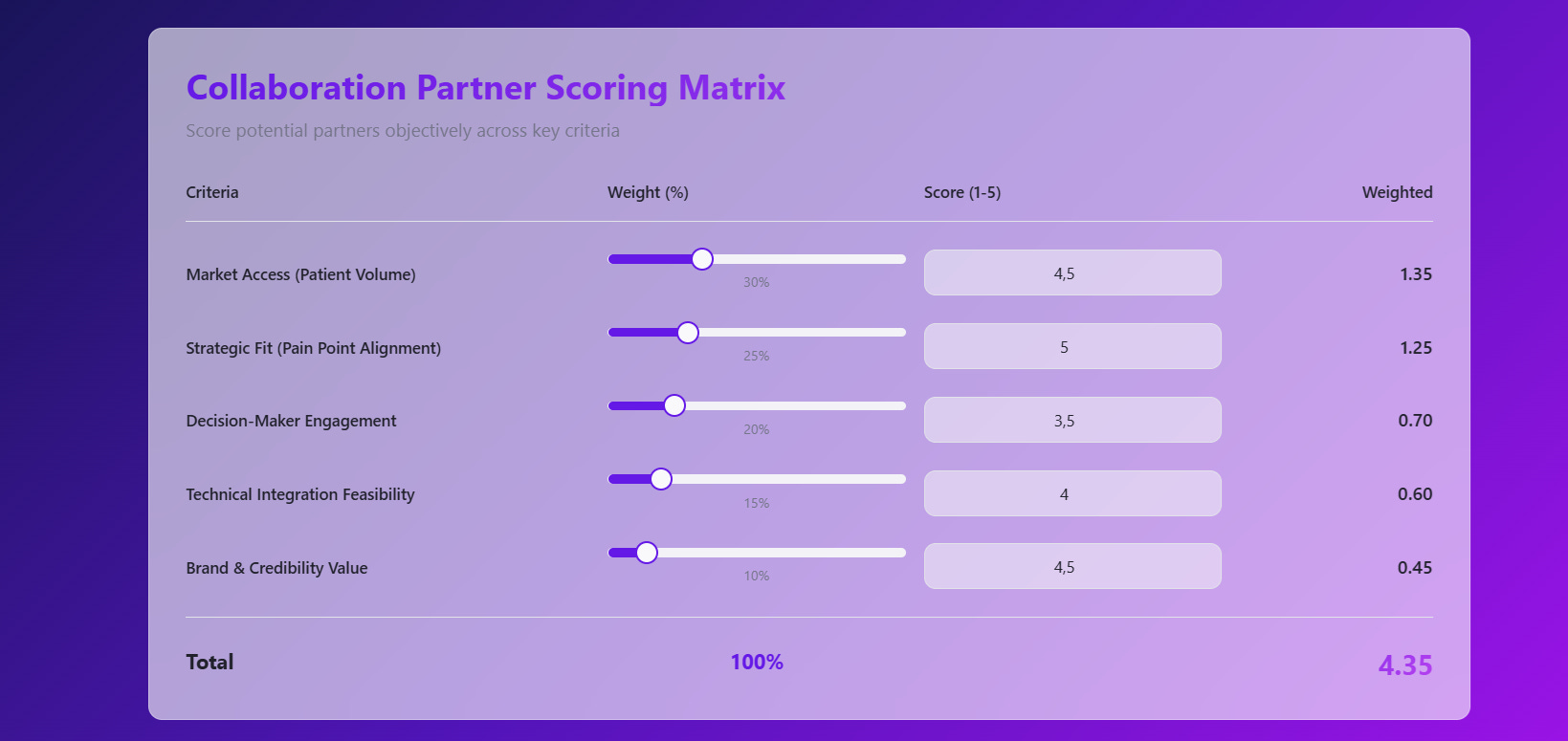
2) Score before you chase (Collaboration Partner Scoring Matrix)
Create a simple table and weight what actually matters to you. Example weights + scoring (1–5):
ICP / Market Access (25%) – Do they reach your exact buyers?
Mission Alignment (15%) – Do you share goals and audience quality standards?
Trust / Brand Fit (15%) – Will their brand add credibility to yours?
Complementary Capabilities (15%) – Do they unlock something you can’t do alone (tech, content, ops)?
Commitment & Speed (15%) – Will they move at your cadence?
Economics & Fairness (10%) – Clear incentive, rev-share, or value swap?
Founder/Partner Psychology (5%) – Do they show low-ego, high-ownership behavior?
Compute a weighted score.
Green zone: ≥ 70% → pursue.
Yellow: 50–69% → pilot small.
Red: < 50% → pass (politely).
Outcome: You replace gut feel with a clear yes/maybe/no, before the calendar fills.
3) Stress-test with AI (Fit Assessment Prompts)
Paste these into Claude/ChatGPT/Gemini before you pitch:
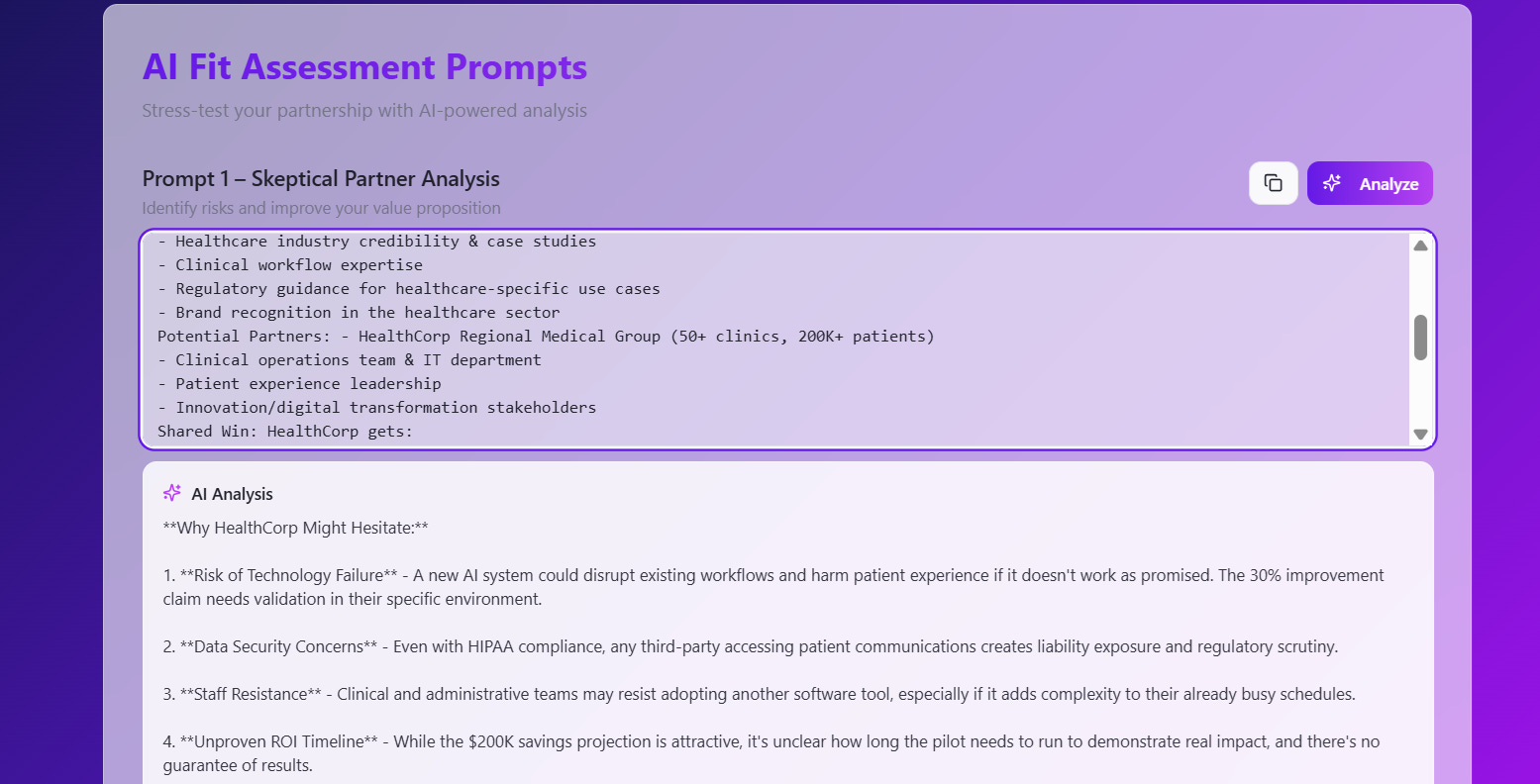
Prompt 1: Skeptical partner analysis
Act as a risk-averse partner manager at [PartnerName]. Based on the info below, list the top 5 reasons you would NOT collaborate with us, then rewrite our value exchange to neutralize those risks in 120 words.
Context:
• What we have: [assets]
• What we lack: [gaps]
• ICP: [your ICP]
• Proposed shared win: [value exchange]
• Desired outcome in 90 days: [metric]
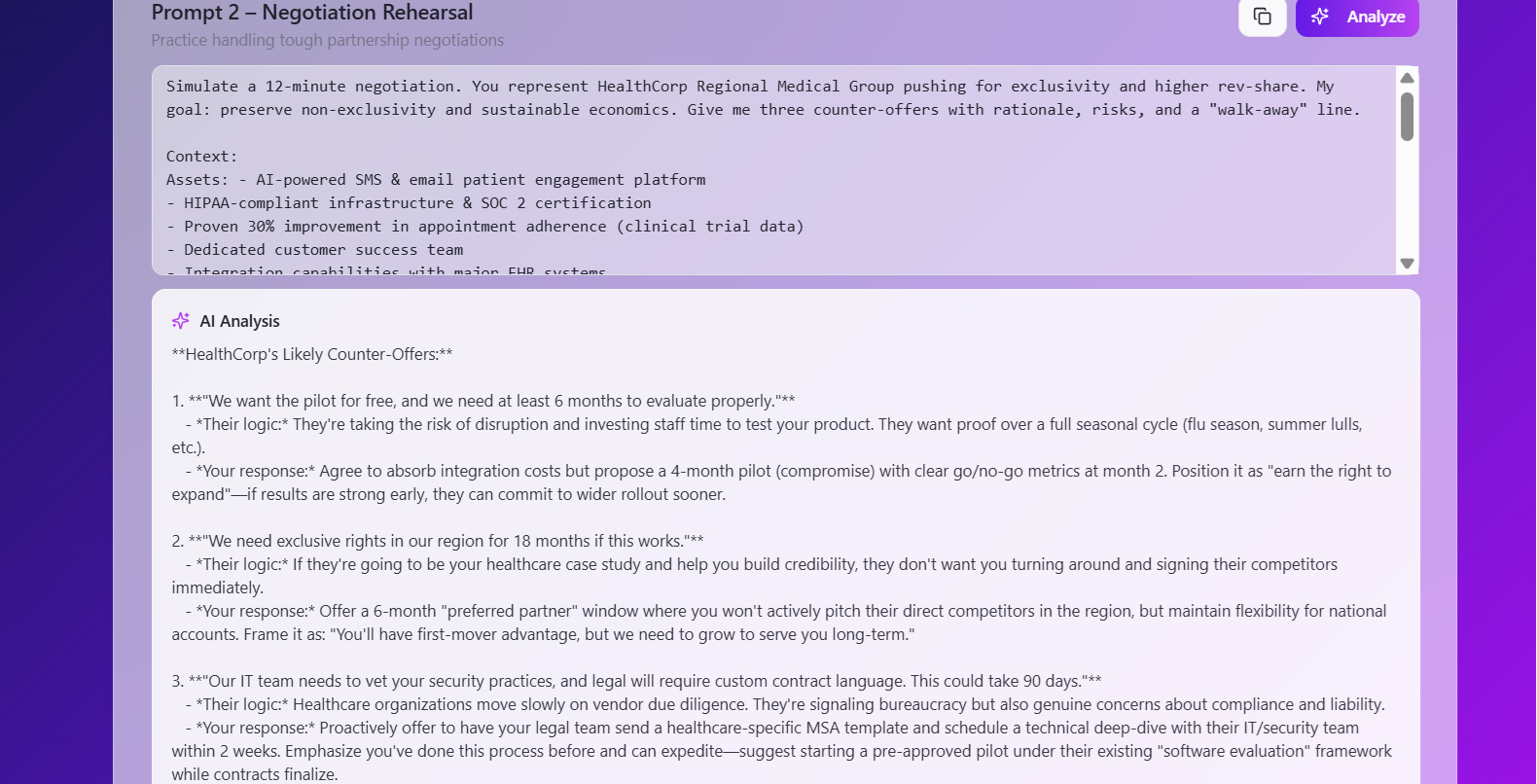
Prompt 2 — Negotiation rehearsal
Simulate a 12-minute negotiation. You represent [PartnerName] pushing for exclusivity + higher rev-share. My goal: preserve non-exclusivity and sustainable economics. Give me three counter-offers with rationale, risks, and a “walk-away” line.
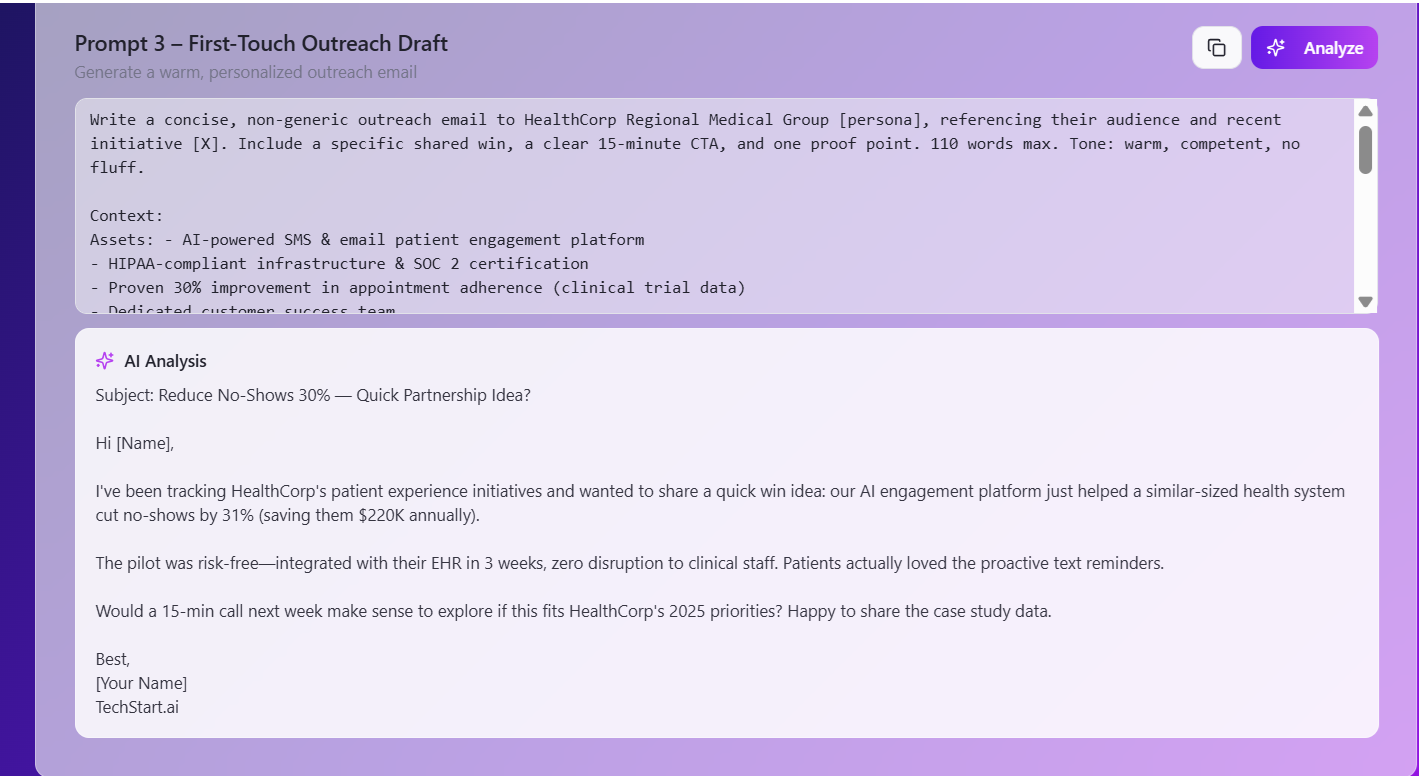
Prompt 3 — First-touch outreach draft
Write a concise, non-generic outreach email to [PartnerName persona], referencing their audience and recent initiative [X]. Include a specific shared win, a clear 15-minute CTA, and one proof point. 110 words max. Tone: warm, competent, no fluff.
Inputs: [your assets], [their audience], [proposed pilot idea]
Outcome: You walk into calls with sharper language, clearer risks, and a realistic next step.
Anonymized example (what this looks like in real life)
A solo SaaS founder I support thought she needed investment. After the canvas + matrix, it turned out she needed distribution more than dollars.
We targeted a niche newsletter (ICP match 5/5, trust 5/5, speed 4/5). AI helped shape the pitch and the rev-share terms.
Result: a co-branded webinar + lead magnet > 420 signups > 37 demos > 6 paying customers in 30 days. Investment conversations after that were easier because traction speaks.
Common mistakes (and how this system prevents them)
Shiny-logo chasing: big brand, wrong audience > the matrix flags it.
Vague value exchange: “let’s explore” > the canvas forces specificity.
Over-committing early: full partnership too soon > start with a pilot (one webinar, one guest post, 30-day test).
No debrief: repeat the same outreach mistakes > use AI to critique your last email/meeting before the next one.
Your next 30–45 minutes
Fill the Canvas (10–15 min).
Score your top 3 candidates in the Matrix (10–15 min).
Run the AI prompts (10–15 min).
Send 1–2 tight, specific emails. Book a 15-minute intro, not a marriage.
The AI-Powered Open Innovation Partner Kit (get it now)
Find Your Perfect Open Innovation Partner in Minutes (Not Months).
Stop guessing. Start winning.
The **Open Innovation Partner Kit** is your strategic compass for evaluating, scoring, and stress-testing collaboration opportunities with AI-powered insights.
✨ Map your strategic assets & gaps
📊 Score partners objectively across key criteria
🤖 Get instant AI analysis to de-risk partnerships
📥 Export comprehensive reports in seconds
I bundled everything into one download so you can act today
Use it to stop guessing and start compounding.
The AI-Powered Open Innovation Partner Kit in action, with example data, screenshots
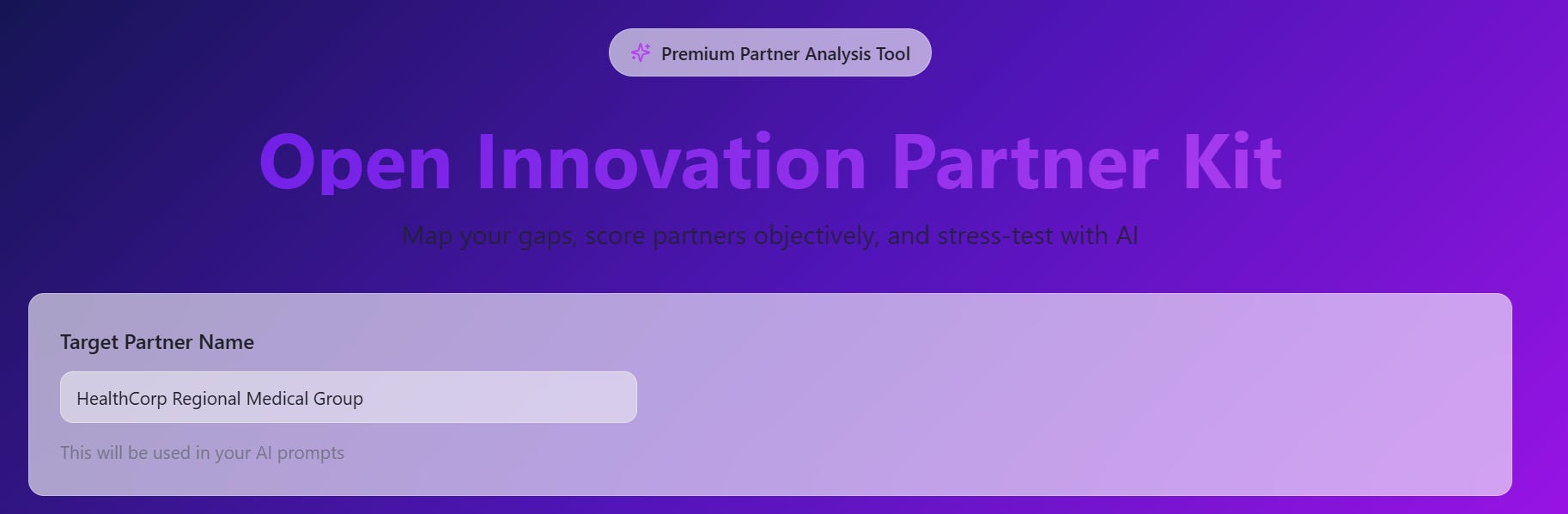
Screenshot 1 (Partner Name Input)
👉 Start by naming the partner you want to evaluate, the system personalizes every insight around that target.
Screenshot 2 (Lite Canvas)
👉 Map your partnership on one page: what assets you bring, what gaps you face, who you could collaborate with, and the shared win for both sides.
Screenshot 3 (Scoring Matrix)
👉 Rate the potential partner across strategy fit, cultural alignment, execution ability, and long-term value, turning gut instinct into data.
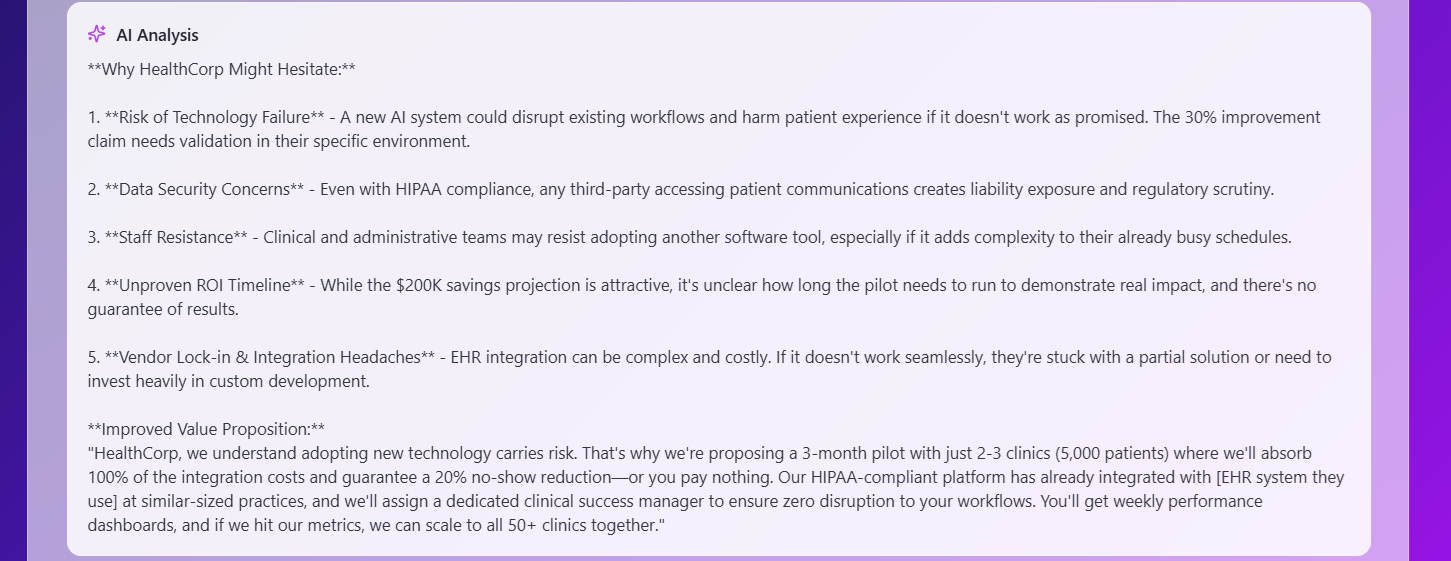
Screenshot 4 - 5 (automated AI prompt and analysis - skeptical partner)
👉 Run AI-powered stress tests: instantly see why a partner might hesitate from tech risks to ROI doubts so you can prepare stronger pitches in advance.
Screenshot 6 (automated AI prompt and analysis - negotiation rehearsal)
👉 Use AI to rehearse tough negotiations simulate counter-offers, see their logic, and get tailored responses so you walk in prepared, not blindsided.
Screenshot 7 (automated AI prompt and analysis - firt touch outreach email draft)
👉 Turn partner insights into action: auto-generate warm, personalized outreach emails with proof points and a clear CTA , so you never stare at a blank screen again.
Screenshot 8
👉 Save your progress and export a polished partner analysis, ready to share with your team or bring straight into the boardroom.

Final thought (and a small ask)
No founder scales alone. The right partner is a force multiplier, if you pick with intent.
If this helped, share it with one builder who’s been grinding solo.
And tell me: Which partner would change your next 90 days?
Optional references (for readers who want to go deeper)
Chesbrough’s Open Innovation (why collaboration accelerates R&D and market access).
HBR pieces on partnership fit and collaboration risk (shared incentives > vague alignment).
My earlier, related pieces:
Such a smart system, it takes the guesswork out of building partnerships. Clear steps like this save time and energy. Thanks for breaking it down so practically.
Thank you so much — that means a lot! 🤝
That’s exactly what I hoped to achieve with this one — to make partnership-building feel less like guesswork and more like a repeatable system you can actually trust.
If you enjoyed this framework, you might like the newsletter too.
I share one practical system every week to help founders and professionals move from fog to clarity. Would love to have you there :)