
Why 83% of Technical Founders Get Ghosted by Investors And the 3-Minute Fix That Changes Everything
Investors aren't saying no to your idea. They're saying no to what they can't see.

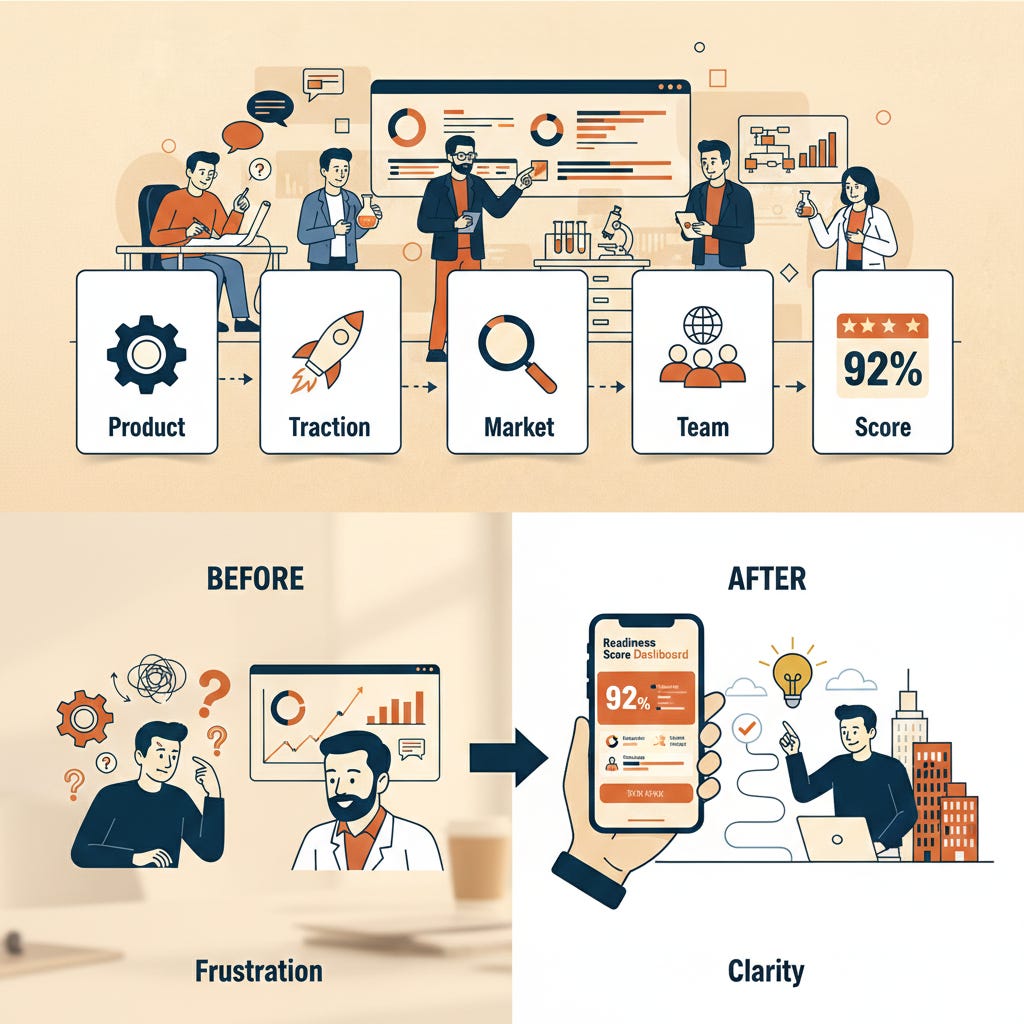
A robotics engineer in Helsinki spent nine months preparing to raise €150K.
He refined his pitch deck 14 times. Rehearsed his demo until it was flawless. Built a prototype that made other engineers jealous. Then he sent 47 cold emails to investors. Got 3 meetings. Heard “impressive technology” twice. Received zero term sheets.
He wasn’t alone.
In the same month, a first-time founder in Copenhagen a former product manager who’d left her corporate job to build a sustainability platform got the same result. Different background. Different product. Same outcome: silence.
And across town, a tech transfer office was struggling to get a single one of their three university spin-outs past the first investor meeting. Brilliant research. Zero investable stories.
Three different people. Three different paths. One identical problem.

The Blind Spot Nobody Tells You About
Here’s what I’ve learned from facilitating investments across 9 European countries and sitting in on 50+ investor conversations:
Early-stage ventures don’t fail at fundraising because the ideas are bad. They fail because they’re invisible.
Not invisible in the literal sense. Founders show up. They pitch. They follow up. Advisors prepare slide decks. Tech transfer offices write executive summaries.
But the story has holes and nobody in the room can see them.
This isn’t just a founder problem. It’s an ecosystem problem.
If you’re a first-time founder, you don’t know what investors actually evaluate. You’ve never been through this before. You’re guessing at what matters and guessing wrong.
If you’re a serial entrepreneur with a new venture, you’ve successfully built and exited before. But your track record won’t carry this one. Investors evaluate the current opportunity, not your biography. And the gap between “I’ve done this before” and “this specific bet is investable” is wider than most repeat founders expect.
If you’re a consultant or advisor helping early-stage startups get investable, you need a diagnostic tool not opinions. Your clients need to know exactly where they stand before you can help them improve.
If you’re a solopreneur building something lean, you might assume fundraising isn’t for you. But when you’re ready to scale, the same investor blind spots apply and you have even less margin for wasted time.
If you’re a tech transfer professional helping researchers spin out companies, you see this constantly: brilliant science, zero commercial framing. The technology scores a 10. The investable story scores a 3. And you don’t always have the tools to bridge that gap quickly.
The cost is the same for all of you. Every month spent chasing the wrong investors or pitching with invisible gaps is a month of runway burned, credibility spent, and momentum lost.
Why Existing Tools Don’t Solve This
You might think, “There are investor readiness tools out there already.”
There are. I’ve tried most of them. Here’s the problem:
ReadyScore.ai uses AI to evaluate 40+ factors but it requires full registration, business documentation, a pitch deck, and financial projections spanning 3-5 years. Useful if you’re Series A ready. Overkill if you’re pre-seed and trying to figure out whether your story is investable at all.
WaveUp’s Fundraising Assessment runs you through 19 quiz-style questions and gives a 0-100% score. Solid tool but it’s attached to a consulting upsell, and the questions lean heavily toward US-based SaaS metrics that don’t always translate to European deep tech or industrial innovation.
Golden Egg Check uses a 21-criteria evaluation model developed from their VC network research. The methodology is credible, but the assessment lives behind a consultation process. You can’t just get a quick, standalone score.
Abaca (powered by Village Capital’s framework) offers a 9-level, 8-category milestone grid. Comprehensive, yes. But it requires account creation, extensive input, and is optimized for accelerator pipelines not individual founders or advisors who need a fast diagnostic.
The pattern is clear: most tools are either too heavy, too slow, too expensive, or too attached to someone else’s sales funnel.
What’s missing is something fast, unbiased, and built specifically for early-stage ventures that need a high-level assessment before they invest weeks into documentation, decks, and data rooms.
That’s exactly what I built.
Introducing the Investor Readiness Score™ by FundEasy
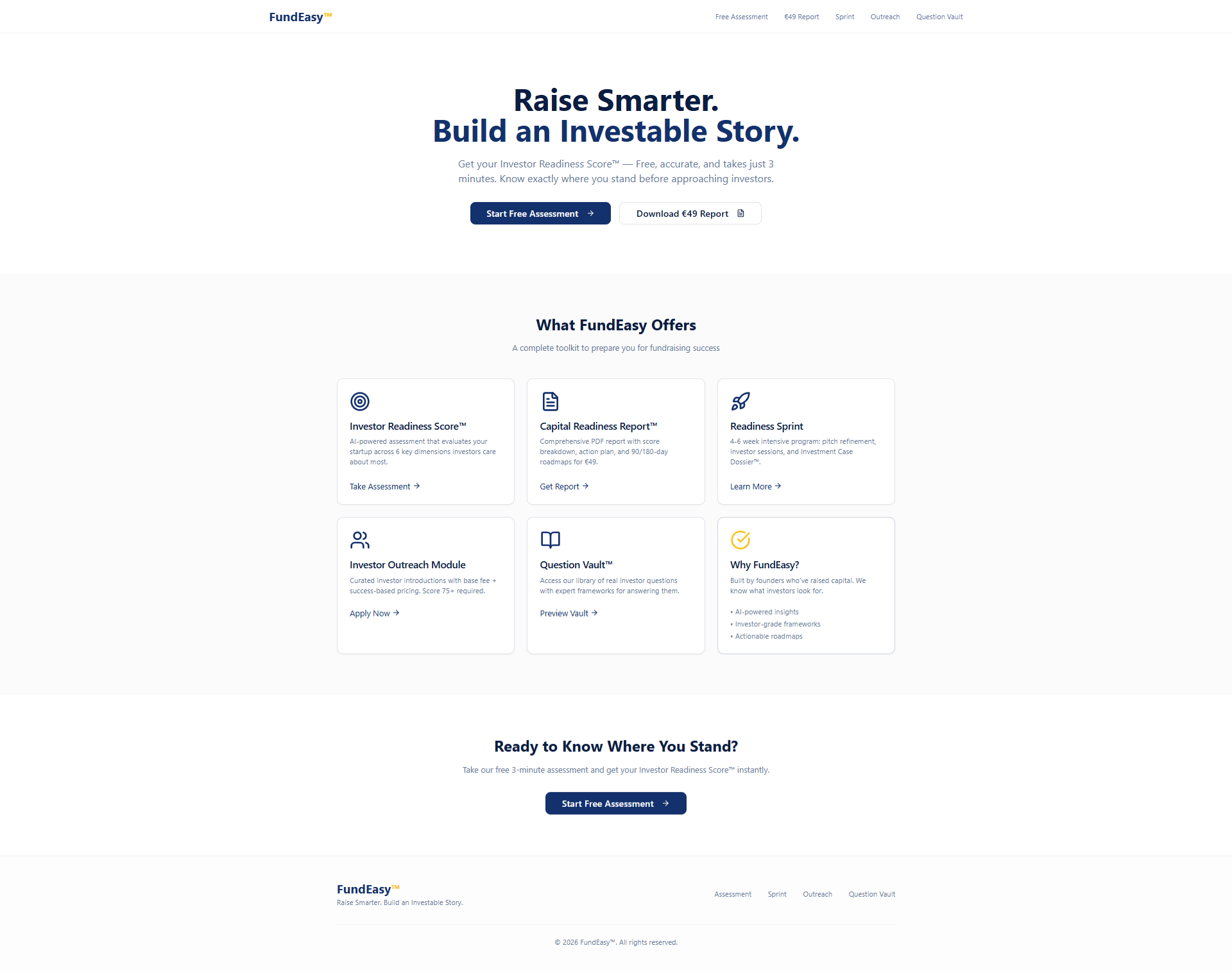
After years of working with founders, advisors, and ecosystem builders and watching the same fixable mistakes repeat I created the Investor Readiness Score™ at howtofundbusiness.com.
It does one thing, and it does it well: it gives you an unbiased, high-level assessment of where any early-stage venture actually stands in the eyes of an investor.
No consulting upsell. No multi-week process. No extensive documentation required.
Here’s what the experience looks like and what you can expect at every step.
Step 1: The Free Assessment (3 Minutes)
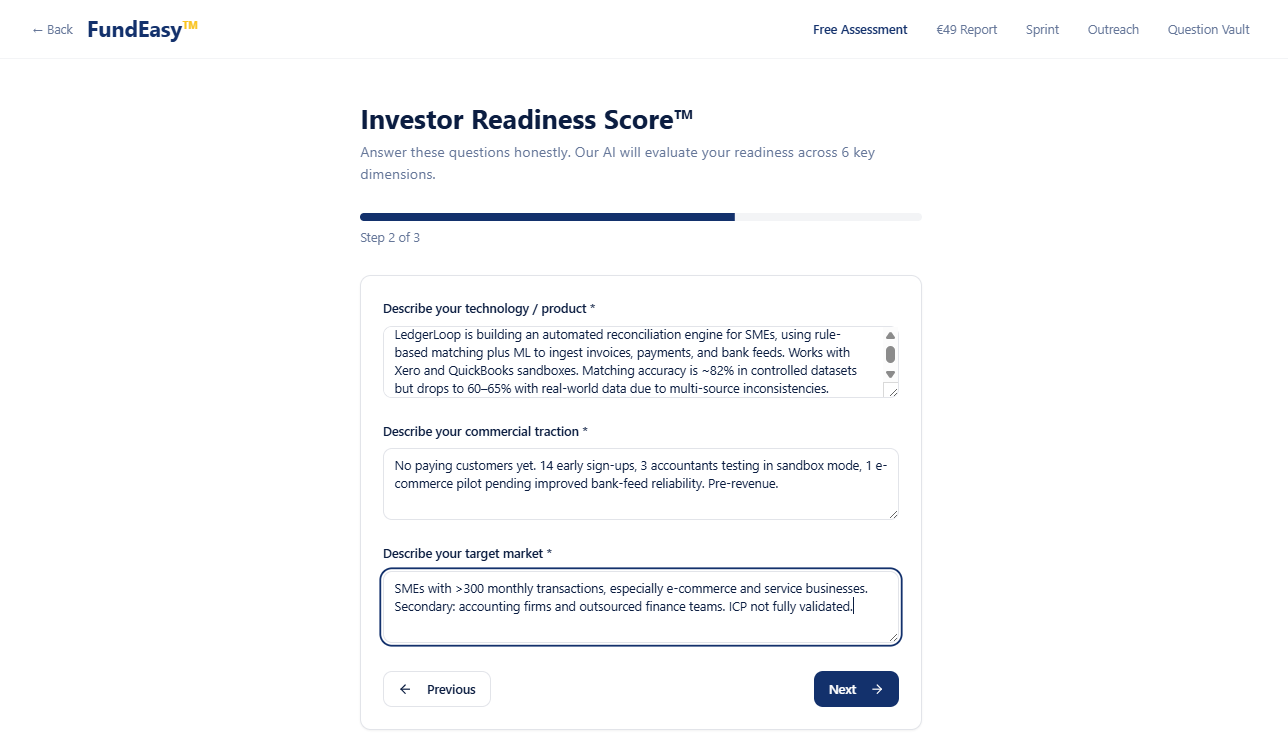
You land on the page. You enter:
→ Your name and email - so we can deliver the report
→ Company name to personalize the assessment
→ Product or business description what you’re building and the problem it solves
→ Commercial traction revenue, pilots, LOIs, waitlists, or whatever evidence you have that someone will pay
→ Target market who specifically you’re selling to
→ Team information who’s building this and what they bring

That’s it. No pitch deck upload. No financial projections. No cap table. Just the core elements that determine whether an investor will lean in or tune out.
What makes this different: The questions are designed to surface exactly the same information that investors evaluate in the first 60 seconds of reading a deck or taking a meeting. This isn’t a theoretical framework, it’s pattern recognition from 50+ real investor conversations across Nordic and European deep tech ecosystems.
⏱️ Time commitment: 3 minutes. Genuinely.
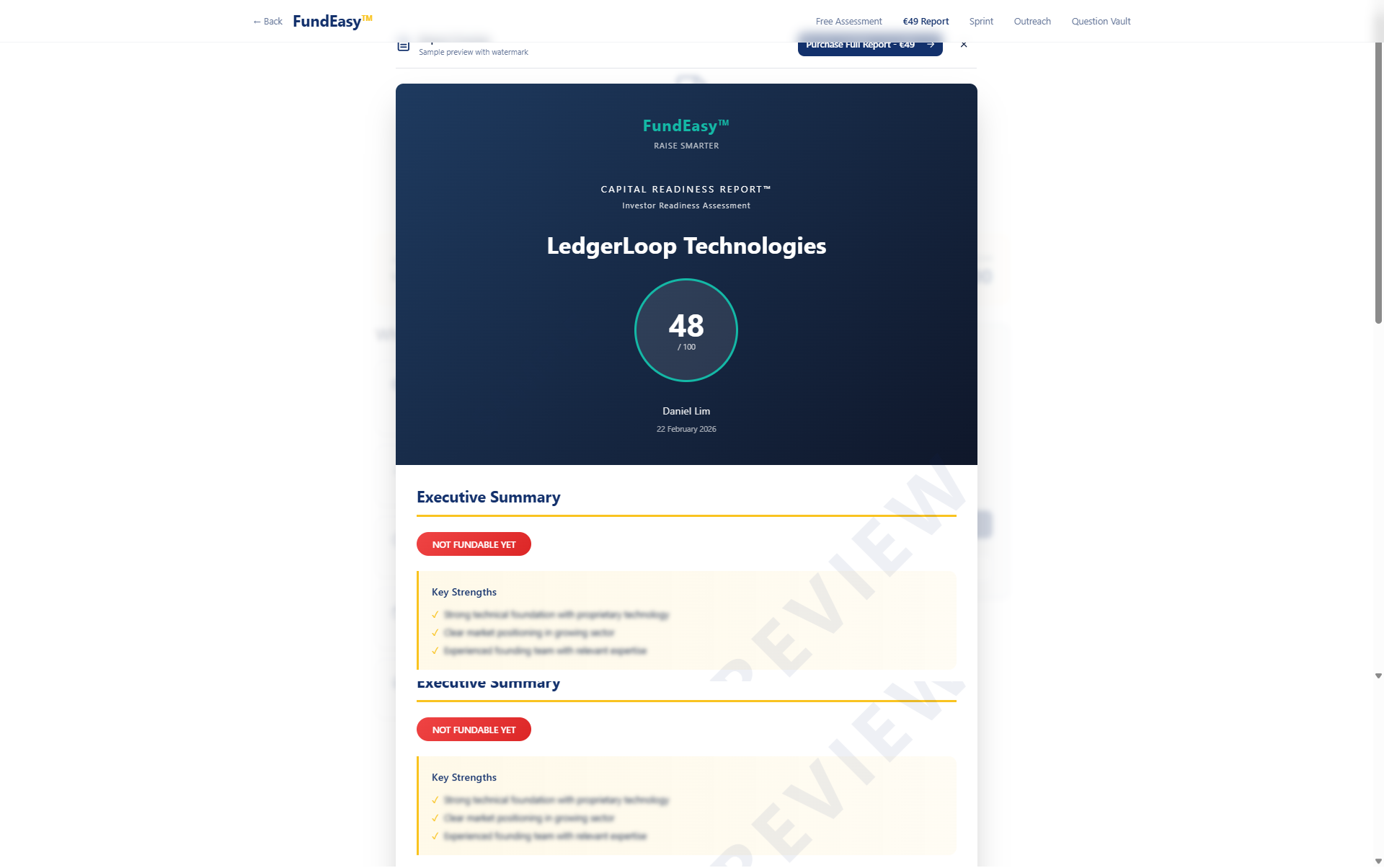
Step 2: The Free Report — Your Investor Readiness Score
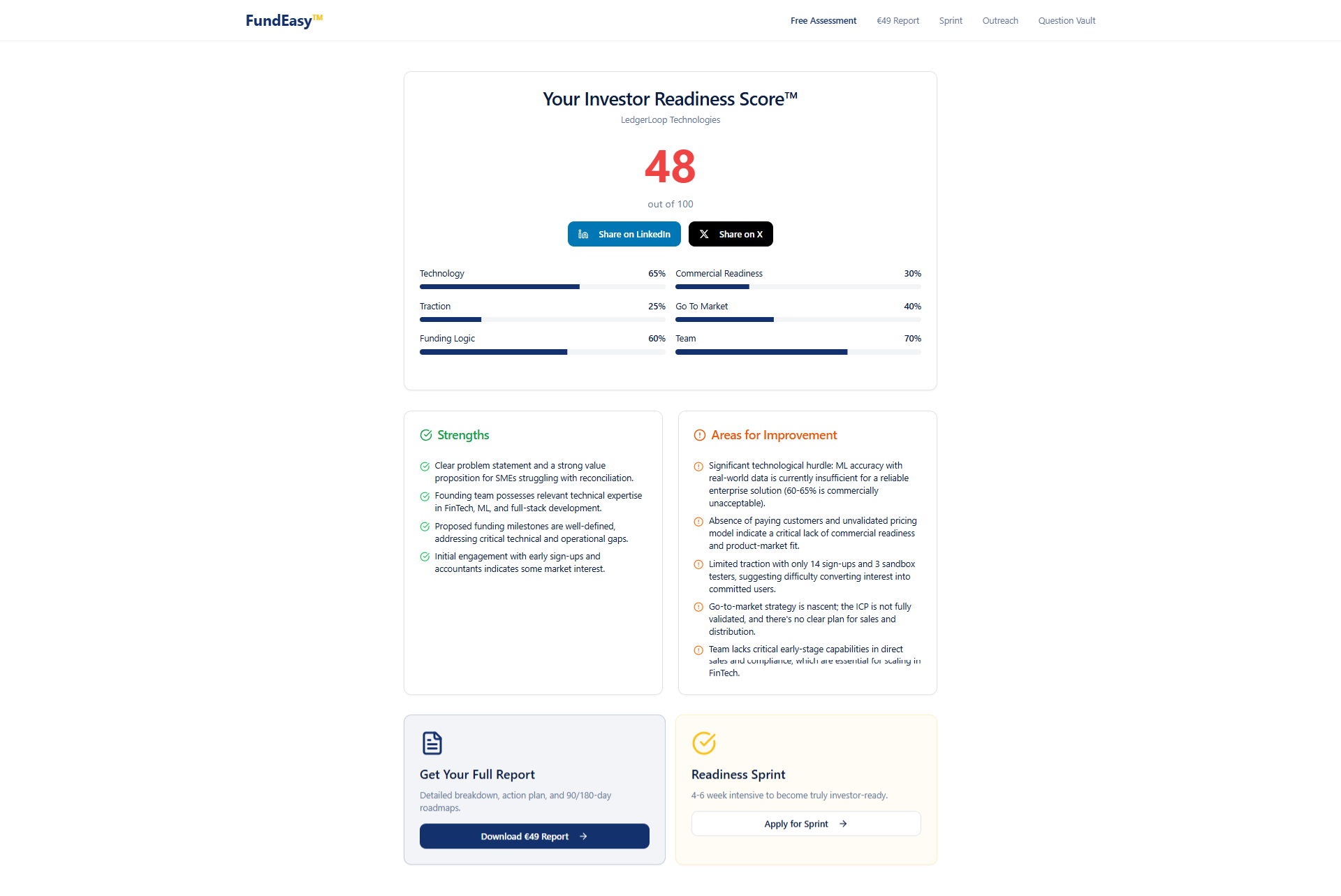
Once you submit, you get a downloadable report. Not a vague “you’re on the right track.” A structured assessment that includes:
→ Your Investor Readiness Score a specific numerical assessment of where the venture stands right now
→ Strengths Identified the parts of your story that are already working. These are the elements you should lead with in investor conversations. Most founders bury their strongest cards because they don’t know they’re strong.
→ Improvement Areas Flagged the specific gaps that would make an investor hesitate. These aren’t generic tips like “improve your pitch.” They’re specific to your inputs your product story, your traction evidence, your team composition, your market definition.
What you can expect: An honest, unbiased mirror. This isn’t a tool that tells you what you want to hear. It’s designed to show you what investors would actually think before you’re sitting across from them.

Who this helps immediately:
→ First-time founders get a reality check on what they thought was ready
→ Serial entrepreneurs discover whether their new venture stands on its own merits
→ Consultants and advisors get a structured diagnostic they can use with every client, no more subjective gut checks
→ Tech transfer professionals can run every spin-out through the assessment before scheduling a single investor meeting
→ Solopreneurs learn whether they’re closer to investable than they think or further than they assume
💰 Cost: Free. No credit card. No trial period. No paywall.
Step 3: The Paid Detailed Report — Go Deeper
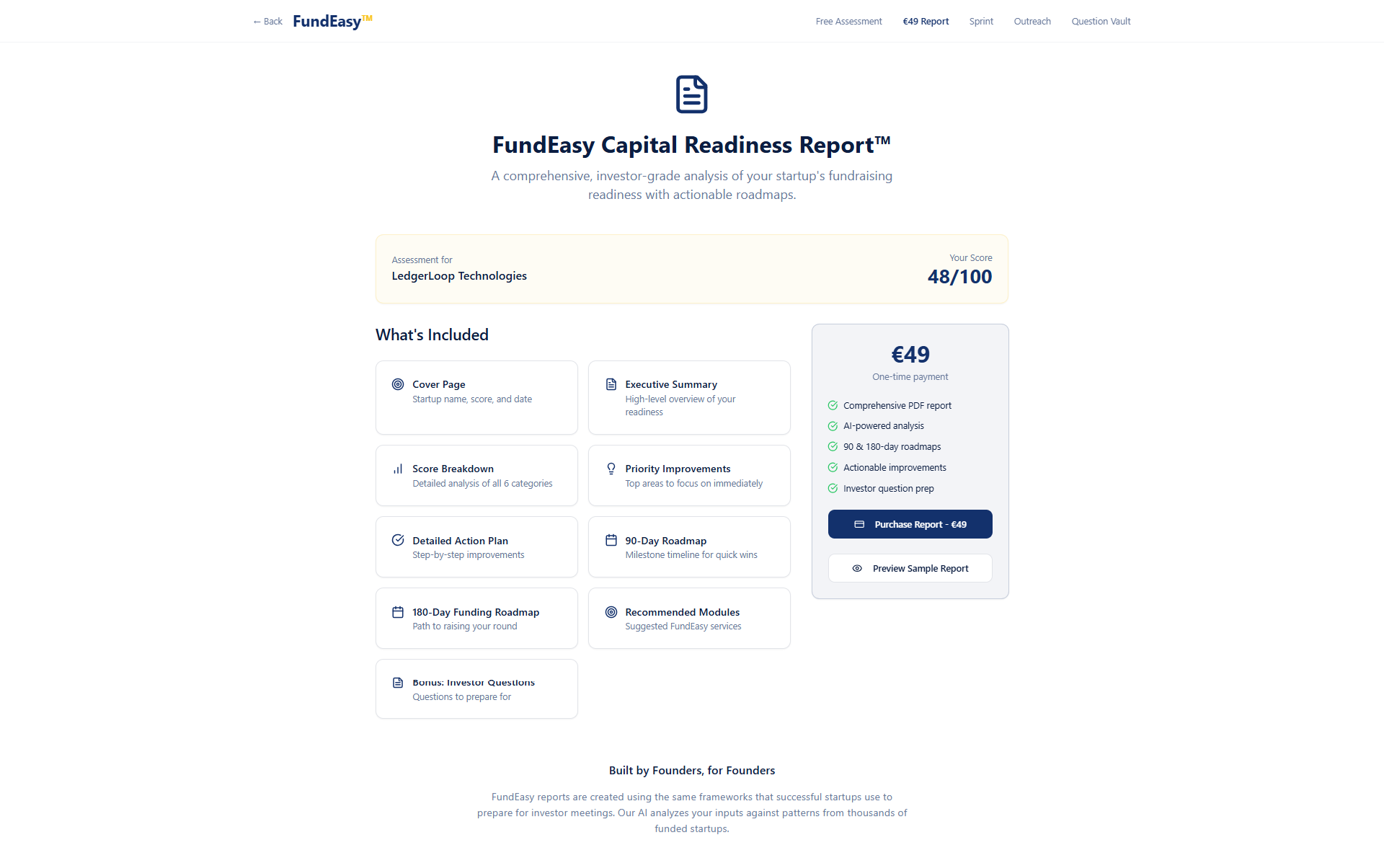
The free report gives you the high-level assessment. For founders and advisors who want to go deeper, there’s an enhanced version that provides:
→ More granular scoring across each dimension
→ Specific, actionable recommendations for closing each gap
→ Benchmarking context where you stand relative to what investors typically expect at your stage
Think of the free report as the X-ray. The paid report is the treatment plan.
What you can expect: A roadmap. Not just “your traction is weak” but “here’s specifically what would make it strong enough to move an investor from maybe to yes.”
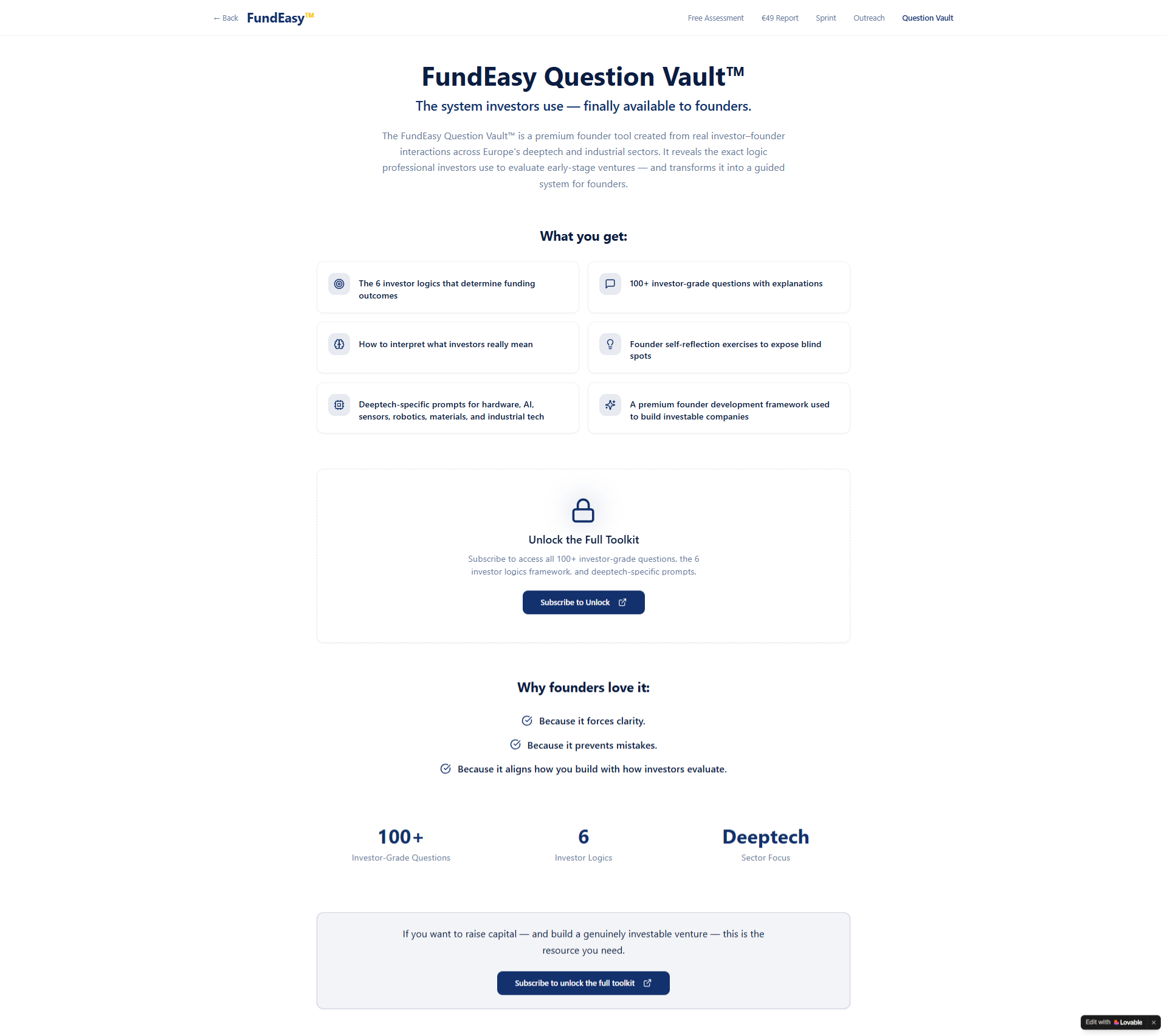
Step 4: The FundEasy Question Vault — Decode Investor Psychology (€29)
Once you know your score and you’ve closed the gaps, you’re ready to take meetings. But here’s what most founders (even experienced ones) get wrong:
They pitch. Then they wait.
Winners do something different. They ask questions that reveal whether the investor is actually a fit before wasting months in a process that was never going to close.
The FundEasy Question Vault gives you 47 psychology-backed questions, built from 50+ real investor conversations. These aren’t generic “what’s your thesis?” questions. They’re designed to:
→ Reveal if you’re in their check size range before you tailor a deck for someone who was never going to write that amount
→ Validate their sector expertise so you know if they actually understand deep tech, or if they’re a generalist pretending
→ Uncover hidden dealbreakers early the objections investors think but don’t say until month 3 of diligence
→ Assess their timeline and process is this a 6-week decision or a 9-month committee slog?
→ Test their seriousness some investors take meetings to learn, not to invest. These questions expose that in 15 minutes.
What you can expect: The ability to qualify investors the way good salespeople qualify prospects. You’ll walk away from bad-fit conversations faster, double down on the right ones sooner, and compress your fundraising timeline dramatically.
Real example: A founder I coached used five of these questions in a first meeting. The investor’s answer to “What does your diligence process look like?” revealed a 9-month timeline with 4 partner meetings. The founder walked away after meeting one. Found another investor who moved in 6 weeks. Same startup. Different investor. The questions saved 8 months.
💰 Cost: €29, lifetime access. One-time purchase. No subscription.
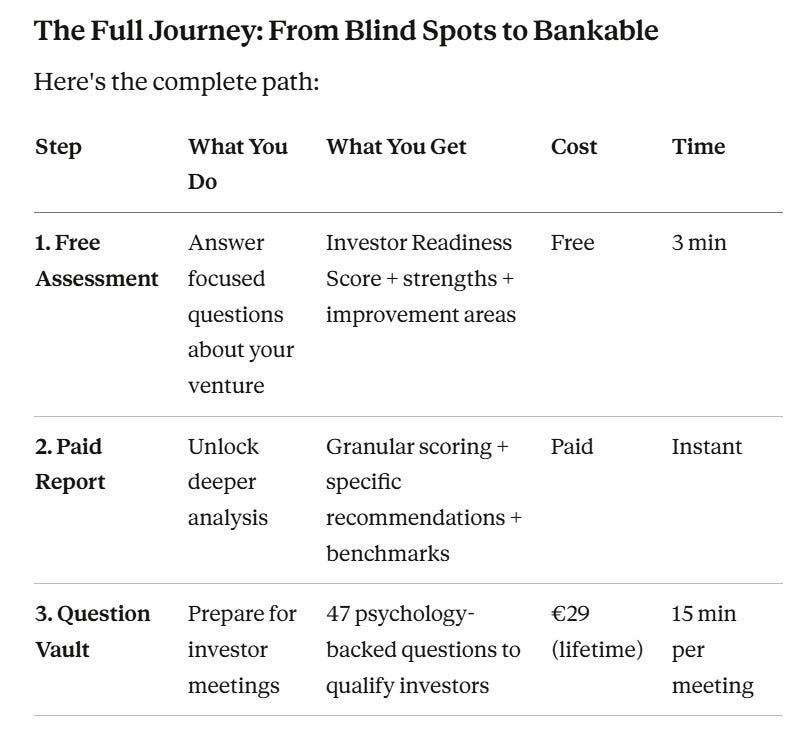
You can stop at Step 1 and get enormous value. Most people who see their gaps for the first time say it’s the most useful 3 minutes they’ve spent on fundraising.
But if you want the full toolkit assessment, roadmap, and investor meeting mastery, the complete journey costs less than a single hour with most startup consultants.
The Founder Who Almost Gave Up
A materials science founder had been trying to raise €100K for 7 months. Impressive technology, a sustainable coating to replace toxic industrial sealants. Two patent applications. A working prototype.
Zero term sheets.
Her tech transfer advisor had done everything right: warm intros, pitch coaching, investor matchmaking. Nothing landed.
When she went through the Investor Readiness assessment, the gaps became obvious.
Her product description focused entirely on the chemistry, not the business case. Her traction section mentioned “conversations with potential customers” but zero numbers. Her target market was “the global coatings industry” , €170B and no specific entry point.
Her score: strong on team and technology. Critically weak on traction and market specificity.
She spent 6 weeks fixing those exact gaps. Signed 2 paid pilots (€8K total). Narrowed her market to Nordic paper and packaging manufacturers. Rewrote her story around the 40% cost reduction her coating delivered.
Her updated score told a completely different story.
She raised €120K in the next 8 weeks from an investor who’d previously ghosted her.
Same founder. Same technology. Same advisor. Different visibility.
Her tech transfer advisor now runs every spin-out through the assessment before a single investor meeting.
Get Your Score. Get Your Clarity. Get Funded.
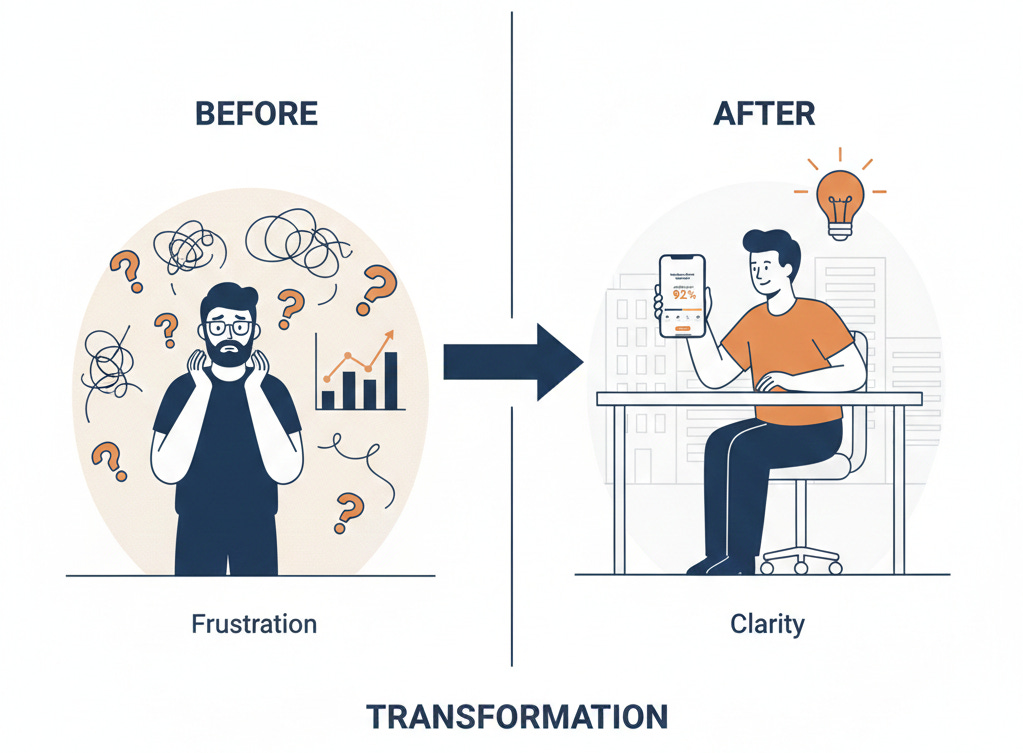
The Investor Readiness Score™ is free. It’s unbiased. It takes 3 minutes. And it works for every scenario:
→ You’re a first-time founder who’s never pitched an investor
→ You’re a serial entrepreneur validating whether your new idea is fundable
→ You’re a consultant who needs a fast, structured diagnostic for clients
→ You’re a solopreneur wondering if your venture is investable
→ You’re a tech transfer professional preparing spin-outs for their first conversation
Click the link. Complete the assessment. Download your report.
Know where you stand. Then go raise smarter.
Every Tuesday, I send one framework that helps founders and ecosystem builders move from fog to focus whether that's validation, customers, or capital. If this was useful, you'll want to be here next week.